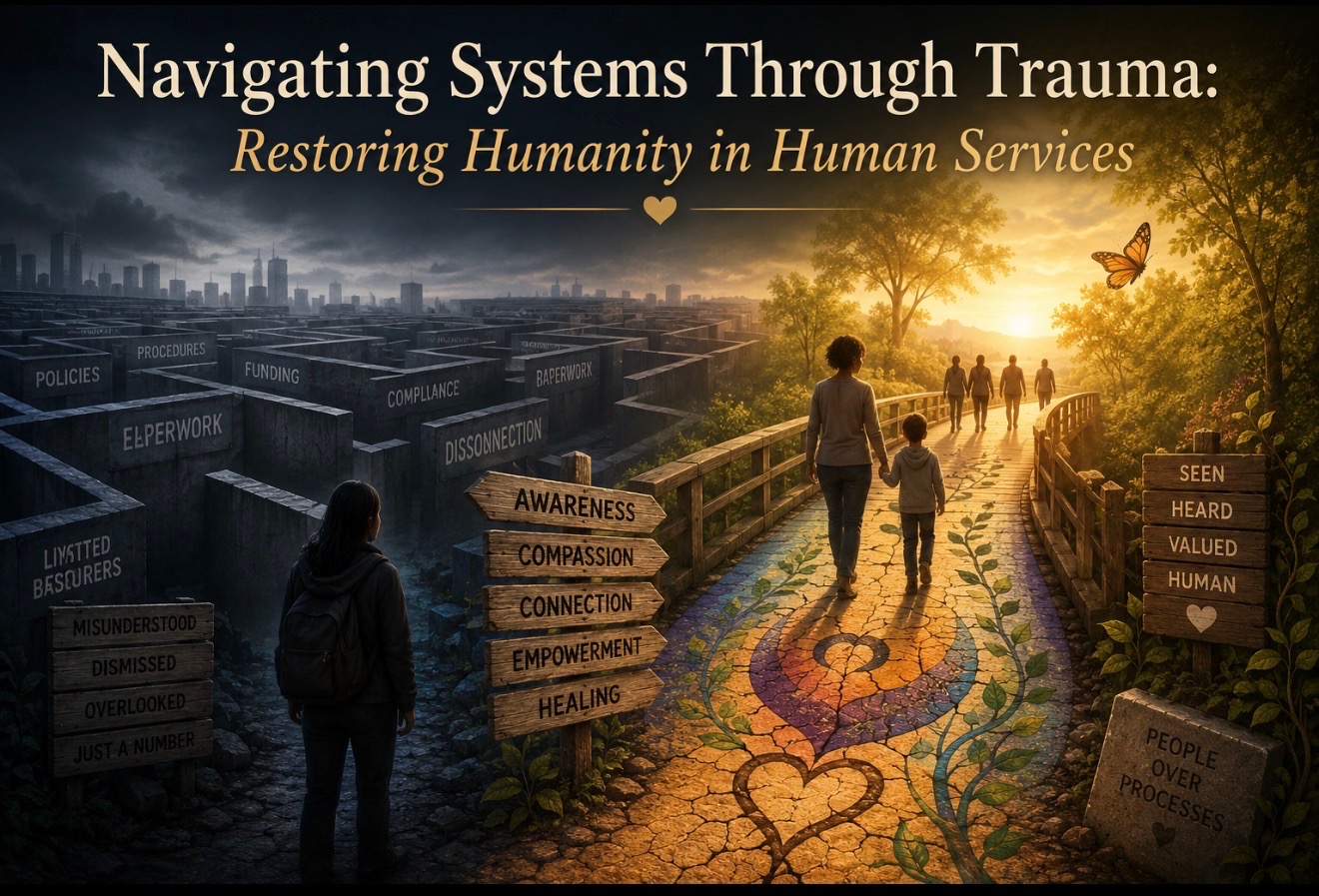
Navigating Systems Through Trauma: Restoring Humanity in Human Services
A SoulScribe Me Inc.
Estimated Read Time: 10+ Minutes
By Tanya Nycole Bates LLC | SoulScribe Me Inc.
Human service systems are built with structure, policies, procedures, and program cycles for a reason. Every initiative has its intended rhythm: assessment, planning, implementation, evaluation, and sustainability.
But human beings are not programs. They do not always move according to timelines, funding cycles, eligibility requirements, or measurable outcomes.
People arrive carrying invisible histories—grief, survival patterns, inherited wounds, fear, loss, uncertainty, and experiences that cannot always be captured in a chart or reduced to a statistic. One of the most concerning realities I have witnessed while working alongside various organizations is the gradual loss of humanity within systems that were created to support humanity. When service becomes disconnected from the soul of the person being served, the work begins to lose its original purpose. A program can be perfectly structured and still fail to reach the spirit of the person standing in front of it.
The human experience is not linear. Healing is not a checklist. Transformation is not always visible through compliance, attendance, or documentation. Yet many systems struggle because they attempt to measure what was meant to be nurtured. Too often, the focus shifts toward financial preservation, productivity expectations, and operational demands while the emotional and human needs of both clients and workers become secondary.
This disconnection often appears in subtle ways. It appears when frontline workers are expected to pour into others while their own basic needs, emotional wellness, and professional value are overlooked. It appears when leadership becomes rooted in control rather than connection. It appears when individuals responsible for creating safe spaces are working inside environments that do not feel safe themselves.
The reality is that many service providers are also carrying their own battles. They are human beings navigating stress, uncertainty, financial pressures, and personal responsibilities while being asked to hold space for others in crisis.
When the people holding the healing container are depleted, the container itself begins to weaken. And everyone feels it. Clients who have already experienced rejection, abandonment, trauma, or instability often recognize when they are being managed instead of understood. They sense when they are being processed instead of seen. They feel when a system is meeting a requirement rather than meeting a human being.
This is where trauma begins to repeat itself—not always through intentional harm, but through disconnection. Clients become frustrated. Workers become exhausted.
Organizations become focused on maintaining the structure instead of transforming the lives within it.
One of the most painful realities is witnessing dedicated professionals—those who entered human services with genuine compassion—become discouraged because they feel as though they are “beating a dead horse.” Not because they have stopped caring. Not because the people they serve no longer matter. But because they begin to recognize the limited power they hold when the systems surrounding them are not designed to support authentic change. They come face-to-face with a difficult truth:
A person can bring light into a room, but if the environment refuses to open its windows, even the brightest light struggles to be felt. Many of the most valuable team members eventually leave—not because they lack commitment, but because their spirit becomes exhausted from constantly trying to create movement within systems that resist evolution. And when those individuals leave, communities lose more than employees.
They lose bridges. They ultimately end up losing the team members who ‘quietly’ understood that healing begins with relationship. That people are just as valuable as stakeholders profits, moreover that great service creates expansion. Good work becomes GREAT work.
A Great Example is When Disconnection Impacts Recovery, Relapse, and Mental Wellness
One of the most overlooked realities within human services is the connection between environment, trauma, mental health, and relapse. Relapse—whether related to substance use, emotional instability, behavioral patterns, or a decline in mental wellness—is often viewed through the lens of personal failure. But healing is rarely that simple. A person does not exist separately from the world around them.
Their recovery is influenced by the relationships they experience, the safety they feel, the consistency of their support, and whether the systems surrounding them reinforce dignity or unintentionally recreate the wounds they are trying to heal. When individuals enter programs already carrying years of trauma, rejection, loss, and survival experiences, their nervous systems are often already overwhelmed.
If they encounter another environment where they feel judged, ignored, controlled, or reduced to a diagnosis or circumstance, the very system designed to support healing can become another source of distress.
This is where we must look deeper. A person may not be “noncompliant.” They may be communicating through their behavior what they have not yet been able to express through words.
Withdrawal may not always be resistance. Anger may not always be defiance. Relapse may not always represent a lack of desire for change.
Sometimes these moments are indicators that a person has reached a place where their internal resources, external supports, or sense of hope have been depleted.
The human spirit requires connection.
Without connection, people often return to what is familiar—even when what is familiar is harmful. For many individuals struggling with addiction or mental health challenges, unhealthy patterns were not created because they lacked strength. They were often formed as attempts to survive pain, regulate emotions, escape overwhelming experiences, or find temporary relief.
Recovery requires more than removing a behavior. It requires restoring the person. This is why human service systems must examine how their approach impacts both the client and the worker.
A burned-out worker may unintentionally deliver a disconnected interaction. A disconnected interaction may reinforce feelings of rejection. A person who already feels rejected may disengage.
Disengagement can lead to isolation. Isolation can increase vulnerability to relapse and mental health decline.
The cycle continues unless someone recognizes the deeper wound beneath the visible behavior. This is why trauma-informed care cannot simply be a training module or organizational phrase.
It must become a way of being. It requires understanding that every interaction carries impact, every conversation has influence.
Every person entering a service environment is asking, whether consciously or unconsciously: “Am I safe here?” …… “Do I matter here?” …. “Will someone see me beyond what I am struggling with?”
When systems answer those questions with compassion, accountability, and genuine presence, they create opportunities for transformation. But when systems respond only with policies, consequences, and procedures, they risk creating another place where people feel invisible. Human services require more than credentials and compliance.
They require presence, humility. They require the ability to recognize the soul beneath the circumstance.
There are too many individuals within helping professions who have become disconnected from the very people they are assigned to support. Some have never taken the time to understand the lived realities of the communities they serve. Without empathy, curiosity, and genuine connection, service becomes transactional.
A person can complete paperwork, follow procedures, and satisfy requirements. But true service requires a deeper consciousness. It requires remembering that every person is carrying a story that existed before they entered the room. Trauma-informed care is not only about understanding the trauma of the client. It is also about understanding the trauma within systems, workplaces, communities, and cultures.
Healing cannot be sustained in environments where humanity is treated as an obstacle instead of the foundation.
Every system holds energy & every human soul is sensitive to it. I recall overcoming “displacement after Hurricane Sandy, the loss of my child, his father and my grandmother. There was so much heaviness to be ‘held’ while being required to LIVE. It was “rare” — to ever sit before someone who could perceive the pain I carried. I vowed to myself “never” to become that.
So the real question is not only how we serve—but what frequency we are emitting service from.
Because people are not cases passing through time. We must remember that we are EACH living consciousness moving through experiences, seeking restoration, recognition, and returning to ourselves on a daily basis. And when systems forget this, the work does not disappear—it simply becomes heavier for everyone inside of it.
Real transformation begins when we remember:
People are not “problems to be managed”. They are not cases to be closed. They are not numbers attached to “funding”.
They are living, evolving beings deserving of dignity, compassion, accountability, and care. When systems reconnect with humanity, service becomes more than a process, it becomes a pathway.
A pathway toward restoration, empowerment, and the return of people to their own sense of worth and possibility. Because the greatest measure of any system is not how efficiently it operates.
It is how deeply it honors the human beings moving through it.
About the Author:


Founder & Principal, SoulScribe Me Inc.
Life Coach | Counselor | Advocate | CRPA | Enigmatic Mystic
Spiritual support, reflective counseling, & soul recovery. Tanya Nycole Bates holds dual Bachelor’s degrees in Psychology and Criminal Justice, with supporting credits in Social Work. She brings over 2 decades of dedicated experience in human services, life coaching, counseling, and advocacy, serving the collective through spiritually grounded guidance and client-centered care. Tanya possesses a certification in Peer Recovery Services (CRPA) and is actively completing her CASAC provisional hours, ensuring her work is both proficient and informed. She offers resources, advocacy, and compassionate support for those navigating life’s transitions, substance recovery, and personal growth.Connect & Follow
- Instagram: @SoulScribe_Me
- Facebook: SoulScribe Me
- Twitter/X: @SoulScribeM
- Fanbase: fanbase.app/soulscribe
- LinkedIn: Tanya Bates on LinkedIn
Learn more: Coaching, writing, workshops, and speaking engagements are available by request.
Email tan@soulscribe.me or DM @SoulScribe_Me to inquire.