A SoulScribe Me Inc.
Estimated Read Time: 20+ Minutes
By Tanya Nycole Bates | SoulScribe Me Inc.
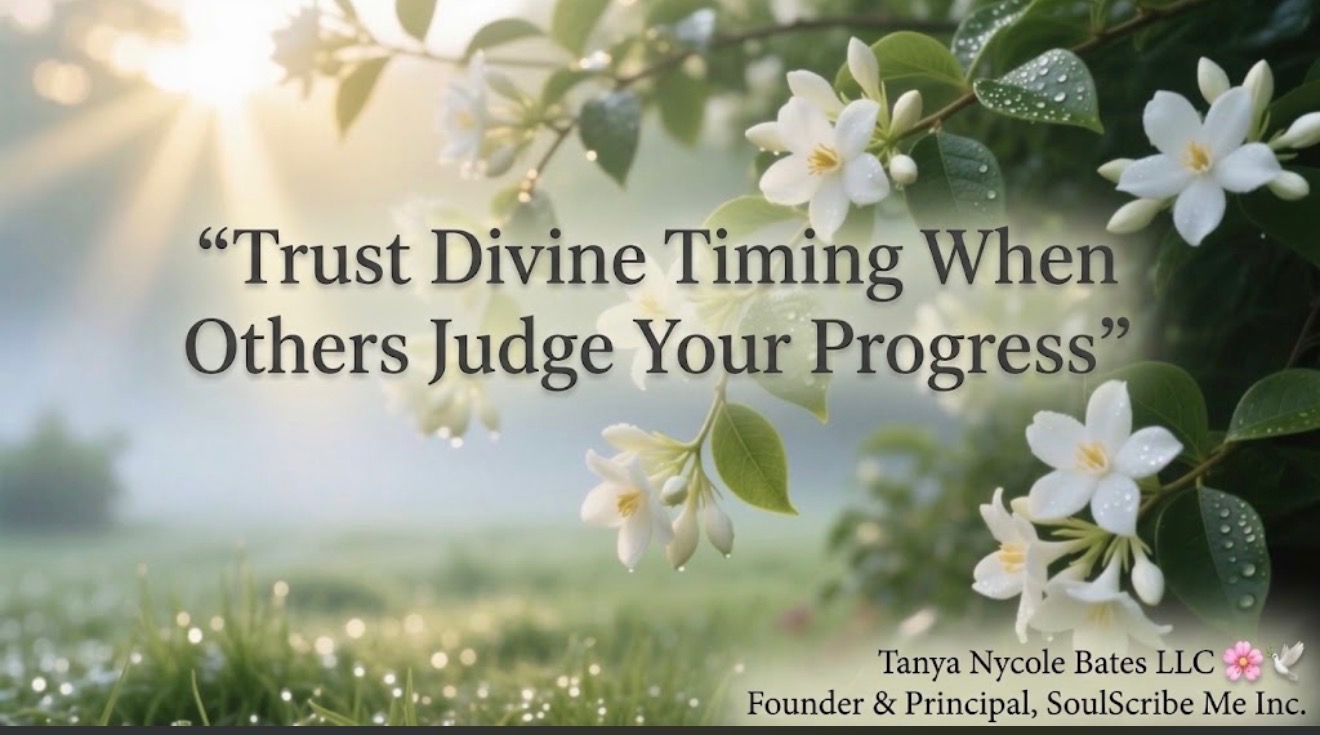
Not every season of waiting is an absence of movement. Sometimes, the most profound transformations occur where the human eye sees nothing happening at all.
Do not rush the process, and never shrink in the presence of modest starts. What appears small to the human eye is often the foundational anchor of a massive cosmic shift.
Trust the unfolding of your path. Every season serves a higher purpose, weaving your soul’s evolution with precise, divine timing. Resist the urge to label your present moment before the full design is revealed.
When you surrender the need to evaluate your growth prematurely, you align with the infinite Intelligence that turns quiet beginnings into extraordinary destinies.
“Therefore judge nothing before the time, until the Lord come, who both will bring to light the hidden things of darkness…”
— 1 Corinthians 4:5, KJV
“For who hath despised the day of small things?”
— Zechariah 4:10, KJV
There is a profound spiritual discipline required to remain faithful to a process that has not yet produced visible evidence of its intended outcome.
It is one thing to trust divine timing when doors are opening, resources are flowing, relationships are flourishing, and the external world appears to validate your direction. It is an entirely different experience to maintain that trust when you have done the work, exercised patience, honored your responsibilities, and continued to show up, yet the circumstances surrounding you remain seemingly unchanged.
This is where faith moves beyond declaration and becomes a lived experience.
It is here that the soul is confronted with a question far deeper than whether it believes in God, the Universe, or a divine intelligence governing existence.
The question becomes: Can you remain anchored in what you know to be true when what you see has not yet revealed the fullness of what you believe?
And perhaps an even more difficult question emerges:
Can you resist the temptation to measure your worth by the opinions of those who have never had to inhabit your waiting?
Because while you are experiencing the internal reality of your becoming, others may be forming conclusions from the external appearance of your circumstances.
You are living the process. They are interpreting the presentation.
And those two experiences are not the same.
The Individual Who Waits and the Observer Who Judges
There is an important distinction between the person experiencing a season of waiting and the person observing it from a distance.
The individual who waits knows the intimate details of the journey. They know what they have attempted, what they have sacrificed, what they have learned, what they have endured, and what remains unresolved. They understand the emotional, practical, and spiritual dimensions of navigating a life that has not yet materialized into the form they envision.
The observer, however, may see only the absence of an expected result.
They see the position that has not been secured, the opportunity that has not materialized, the relationship that has not progressed, the business that has not yet expanded, or the person who appears to be standing in the same place.
From that limited vantage point, the observer may conclude that nothing is happening.
But what if the absence of visible progress does not tell the complete story?
What if the person is developing discernment, acquiring knowledge, establishing boundaries, refining their purpose, or learning to recognize the difference between an opportunity that aligns with their values and one that merely satisfies their immediate desire?
What if the waiting has exposed weaknesses in systems, relationships, and institutions that would otherwise have remained undiscovered?
And what if the person is not simply waiting for a door to open, but learning what must be understood before entering the next room?
Human beings are often tempted to confuse visibility with validity.
We see what is measurable and assume it is what matters most. We celebrate outcomes while overlooking the years of preparation that preceded them. We admire the harvest while remaining largely indifferent to the conditions required for the seed to take root.
Yet a seed does not become less significant because it has not broken through the soil.
Its invisibility is not proof of its insignificance.
Likewise, a person’s current circumstances are not sufficient evidence of their entire capacity, character, potential, or future.
The observer sees a moment. The individual is living a continuum.
And when we mistake a moment for the entirety of a person’s story, our conclusions may become more reflective of our limitations than of their reality.
The Unseen: What Is Happening Beneath the Surface?
In nature, not every process announces its progress.
The roots of a tree extend beneath the earth long before its branches provide visible evidence of expansion. A seed undergoes a period of development concealed from the world above it. The changing seasons do not always produce immediate signs of what is taking place within the larger cycle of life.
Nature does not require every stage of development to be publicly observable before that stage can be meaningful.
Why, then, do we so frequently demand that human beings provide visible evidence for every season of their lives?
From a metaphysical perspective, the unseen represents the dimension of existence that cannot be fully understood through immediate sensory observation. It invites us to consider that reality may contain processes, relationships, possibilities, and developments that have not yet become apparent.
This does not mean that every delay is divinely orchestrated, that every disappointment conceals a predetermined blessing, or that every closed door should be interpreted as a supernatural instruction.
Rather, it invites a more discerning understanding of uncertainty.
We may not control every circumstance, but we can choose how we respond to what has not yet been resolved. We can use periods of uncertainty to develop greater self-awareness, strengthen our judgment, prepare for opportunities, and determine which parts of our lives require action rather than continued patience.
Sometimes, the transformation is spiritual.
Sometimes, it is intellectual.
Sometimes, it is practical.
And sometimes, it is the difficult recognition that a system, relationship, or environment is not providing what we need and that a different course of action must be taken.
The sacredness of the process does not depend on pretending that everything is perfect.
It rests in our willingness to remain conscious within the imperfection.
There is a difference between believing that the unseen guarantees a particular outcome and understanding that the absence of immediate evidence does not grant us permission to declare that no meaningful development is possible.
The first demands certainty about the future.
The second practices humility in the present.
And humility is essential when navigating a reality larger than our individual perspective.
The Violence of Premature Conclusions
There is a form of judgment that does not require an insult to inflict harm.
It can appear as dismissal, assumption, premature interpretation, or the quiet decision that another person’s circumstances reveal something definitive about their character.
A person is struggling, so they must lack discipline.
A person is waiting, so they must lack direction.
A person has not achieved a particular milestone, so they must not be capable of achieving it.
A person is caught in a complicated situation, so the situation itself must tell us everything we need to know about them.
These conclusions may offer the observer a sense of certainty. They simplify complexity and create the illusion that another person’s circumstances can be understood without examining the circumstances themselves.
But simplicity is not the same as truth.
And confidence is not the same as discernment.
First Corinthians 4:5 offers a powerful warning against judging before the appropriate time, particularly when the hidden dimensions of a matter have not yet been brought to light.
The principle extends beyond a person’s spiritual standing. It challenges our impulse to treat incomplete information as a sufficient foundation for a final conclusion.
How often do we judge the visible evidence without understanding the conditions that produced it?
How often do we evaluate a person’s response without examining what preceded it?
How often do we determine who someone is based on one chapter while remaining ignorant of the chapters that shaped their decisions, their understanding, and their present circumstances?
The danger is not simply that we may misunderstand someone.
The danger is that we may begin treating our misunderstanding as authority.
We may speak as though we know what another person should have done, what they should have anticipated, how quickly they should have recovered, or what their circumstances supposedly prove.
Yet we are not always positioned to know the full story.
Sometimes, the most spiritually mature response is not to reach a conclusion but to acknowledge the limits of what we can legitimately conclude.
Discernment asks us to examine. Judgment rushes to define. Wisdom knows the difference.
This does not mean abandoning accountability or refusing to recognize harmful conduct. Accountability requires us to examine actions, evidence, responsibilities, and consequences. What it does not require is pretending that a partial understanding grants us complete knowledge of another human being.
We can hold people accountable without reducing them to their most difficult moment.
We can acknowledge facts without inventing motives.
We can recognize consequences without claiming omniscience.
And we can allow an unresolved matter to remain unresolved in our minds until there is sufficient understanding to assess it fairly.
That restraint is not weakness.
It is intellectual honesty accompanied by spiritual discipline.
4. The Case of Job: When a Person Becomes the Subject of a Story Others Believe They Understand
Consider the situation involving Job.
When a person becomes the subject of a disputed encounter, an allegation, or a consequential institutional process, there is often a distance between what the public can readily observe and what must actually be examined.
An incident may become the defining feature of how others perceive that individual. A brief account may circulate. A conclusion may begin to form. People who have never experienced the person’s circumstances may develop opinions about what happened, what should have happened, or what the individual deserves.
But a person’s life is not a single event.
Nor is an allegation, an initial account, or an observer’s interpretation automatically equivalent to an established finding.
In a situation such as Job’s, the distinction between observation and judgment becomes especially important. Where the circumstances are disputed, a fair assessment requires attention to the evidence, the sequence of events, the applicable standards, and the individual’s opportunity to have the matter examined properly.
The significance of this example extends beyond the particulars of any one case.
It asks us to consider what happens when people become more invested in the story they have formed than in the truth that must be established.
What happens when the visible incident becomes more important than the questions that remain unanswered?
What happens when an individual’s present circumstances are treated as a complete representation of their character?
And what happens when those who are observing forget that the person at the center of the matter must live with its consequences while the observers remain free to move on to their next opinion?
The observer may offer a sentence.
The individual may have to navigate the consequences of that sentence for months or years.
The observer may feel certain.
The individual may still be seeking clarity, resolution, and a fair opportunity to have the circumstances understood.
The observer may believe the matter is simple.
The individual may know that its implications are anything but simple.
This is why restraint matters.
It is not necessary to know every detail of Joe’s circumstances to recognize the ethical importance of distinguishing between what has been observed, what has been alleged, what has been established, and what remains unknown.
Those distinctions protect more than an individual’s reputation. They protect the integrity of our own judgment.
The spiritual lesson is not that we must automatically agree with the person at the center of a dispute. It is that we must resist the urge to substitute assumption for examination.
There is a difference between standing for truth and standing behind the first version of a story that reaches us.
There is a difference between accountability and condemnation.
And there is a difference between witnessing someone’s circumstances and claiming to understand their entirety.
Sometimes, the most consequential act of fairness is to refuse to make a person’s unfinished story into a finished verdict.
This principle applies not only to public or institutional matters but also to the private judgments we make about those navigating unemployment, delayed opportunities, personal transitions, family difficulties, or seasons of profound uncertainty.
The circumstances may differ.
The responsibility remains.
We must be careful not to confuse what we can see with all that there is to know.
The Spiritual Burden of Being Misunderstood While You Wait
There is a particular kind of exhaustion that accompanies waiting when the people around you interpret your circumstances as evidence of personal failure.
It is one thing to navigate uncertainty.
It is another to navigate uncertainty while feeling compelled to explain why you have not yet arrived at a destination that others believe you should have reached.
The waiting itself demands patience, strategy, emotional regulation, and perseverance. The additional burden of defending your progress against external assumptions can consume the very energy required to continue moving forward.
You may begin to question yourself, not because your direction has necessarily become less meaningful, but because the repeated exposure to other people’s conclusions creates pressure to see yourself through their eyes.
You may feel compelled to produce results prematurely.
You may be tempted to accept an opportunity that is inconsistent with your values simply to demonstrate that you are moving.
You may abandon a necessary period of preparation because someone else has decided that the time you have taken is excessive.
Or you may begin measuring your life against a timetable that was never yours to begin with.
This is where waiting becomes a test of self-definition.
Can you distinguish between constructive feedback and uninformed commentary?
Can you recognize when an observation contains useful information and when it merely reflects someone else’s expectations?
Can you remain open to correction without surrendering your identity to another person’s opinion?
And can you acknowledge that a process may need adjustment without concluding that your entire journey has been a mistake?
These are not small questions.
They determine whether you can remain accountable to your own development while navigating the unavoidable presence of external judgment.
Spiritual maturity does not require you to dismiss everyone who questions you. Sometimes, a question reveals a blind spot. Sometimes, another person can see a practical concern that you have overlooked. Sometimes, the delay is an invitation to reassess your approach, acquire additional skills, seek support, or take a different route.
But constructive reflection and the internalization of every external opinion are not the same thing.
You can listen without surrendering your discernment.
You can reassess without abandoning yourself.
You can recognize that progress is slower than you anticipated without declaring the process meaningless.
And you can remain committed to your purpose while accepting that commitment alone does not guarantee a particular outcome or timetable.
Your responsibility is not to convince every observer that your life is unfolding correctly.
Your responsibility is to remain honest about where you are, conscious of what is within your control, and willing to take the next meaningful step.
Job’s Friends and the Arrogance of Assuming We Know Why Someone Is Suffering
The biblical account of Job offers another profound reflection on the dangers of interpreting another person’s circumstances without sufficient understanding.
Job experiences devastating losses, physical suffering, and profound uncertainty. His friends arrive and attempt to interpret his suffering through their own assumptions about righteousness, wrongdoing, and divine justice.
Rather than simply remaining present to the complexity of his experience, they repeatedly offer explanations that place the burden of interpretation on Job himself.
Their reasoning assumes that his suffering must correspond to some hidden failure or wrongdoing.
In their framework, the severity of the circumstances becomes evidence for the conclusion they have already formed.
But the reader is given a perspective that Job’s friends do not possess. The opening chapters reveal a larger spiritual context that complicates their confident explanations.
Their error is not that they attempt to understand suffering. It is that they presume to understand more than they actually know.
There is a lesson here for anyone who has ever watched another person struggle and felt compelled to explain why.
We may observe someone who has lost an opportunity and decide that they were not prepared.
We may see someone whose life has not progressed according to conventional expectations and conclude that they lack discipline.
We may encounter a person facing repeated obstacles and assume that the obstacles must be evidence of their own shortcomings.
But the Book of Job challenges the simplistic belief that circumstances can always be read as a direct reflection of a person’s moral standing or spiritual condition.
Suffering is not a reliable instrument for measuring someone’s worth.
Delay is not a definitive verdict on someone’s character. And an observer’s inability to explain a person’s circumstances does not mean that the person has failed to understand their own life. Sometimes, we must allow another human being to inhabit the mystery of their experience without imposing our explanations upon it.
Sometimes, compassion means listening without diagnosing. Sometimes, wisdom means acknowledging that we do not know why a particular season has unfolded as it has.
And sometimes, the most faithful response is to remain present without pretending to possess an answer. Job’s story reminds us that certainty can become spiritually dangerous when it is built upon assumptions rather than understanding.
It also reminds us that a person can be experiencing profound difficulty without that difficulty constituting proof of personal inadequacy.
We must be careful not to become so attached to our explanations that we lose sight of the person standing before us.
The Day of Small Things: Why Modest Beginnings Must Not Be Despised
Zechariah 4:10 asks a question that remains deeply relevant to anyone building a life, developing a calling, or navigating a period of transition:
“For who hath despised the day of small things?”
The question challenges our tendency to assign value according to scale.
We are conditioned to recognize achievement when it becomes visible, impressive, measurable, or socially celebrated. We admire the established business, but may overlook the first client. We applaud the completed degree, but may disregard the hours spent studying while managing competing responsibilities. We celebrate the successful professional, but may know little about the years of preparation, rejection, or uncertainty that preceded the achievement.
We often honor the outcome more readily than the conditions that made it possible.
Yet beginnings are rarely impressive by conventional standards.
A beginning may consist of one application, one conversation, one completed assignment, one newly acquired skill, one act of self-discipline, or one decision to approach a familiar problem differently.
It may look like very little. But smallness and insignificance are not synonymous.
A modest beginning can establish a pattern. A single decision can redirect a course of action. One meaningful connection can introduce an opportunity that was previously inaccessible. One honest assessment can prevent years of pursuing a direction that no longer serves a person’s objectives.
The point is not to romanticize every small step or pretend that every beginning will produce extraordinary results.
The point is to recognize that meaningful development often begins before it attracts recognition.
A person may be building capacity long before they acquire authority.
They may be developing expertise long before they receive the position that allows them to demonstrate it.
They may be establishing the foundations of a business long before its financial performance reflects the labor invested in it.
And they may be learning how to navigate a system long before that system provides the opportunity they have been working toward.
There is no shame in beginning modestly. There is no inherent failure in needing time to develop.
There is no reason to despise the stage of the journey that has not yet acquired the appearance of accomplishment.
But there is an important distinction between honoring small beginnings and remaining passive in circumstances that require action.
Faithfulness to a beginning does not mean refusing to grow beyond it.
It means respecting what the beginning is teaching you while remaining willing to do the work required for the next stage.
Do not despise the beginning simply because it has not yet become the evidence you hoped to present to the world.
Learn from it. Strengthen it. Build upon it. And remain honest about what it requires of you.
Divine Timing Is Not a License for Passivity- There is a necessary balance in any serious discussion of divine timing.
Trusting a spiritual process does not mean assuming that every delay is a divine instruction to remain exactly where you are.
Not every closed door is a sign to wait outside it indefinitely. Not every obstacle is a test of endurance.
And not every disappointing outcome is proof that something better is being prepared elsewhere.
Sometimes, a delay occurs because resources are limited. Sometimes, an institution is inefficient. Sometimes, a decision-maker has failed to act. Sometimes, a person needs additional preparation. Sometimes, the original plan requires revision.
Spiritual maturity allows us to hold faith and practical discernment together.
We can pray and still follow up. We can trust and still investigate. We can remain patient while establishing reasonable boundaries.
We can accept that a process takes time while asking whether the process is functioning as it should.
We can believe that our lives possess meaning without assuming that every circumstance has been arranged for our benefit.
And we can recognize that we are not responsible for controlling every outcome while remaining responsible for the decisions available to us.
Waiting, when practiced consciously, is not an abandonment of agency. It is the disciplined management of what can and cannot be controlled.
The individual who waits wisely continues to learn, prepare, document, reassess, seek appropriate assistance, and respond to new information. They do not need to manufacture urgency simply to satisfy an observer, but neither do they need to confuse prolonged uncertainty with a requirement for endless endurance.
Sometimes, the next faithful step is to remain steady. Sometimes, it is to ask a difficult question.
Sometimes, it is to challenge an unfair process. Sometimes, it is to change direction.
And sometimes, it is to acknowledge that the answer has not yet arrived and make the best available decision with the information currently in hand.
The sacredness of waiting is not measured by how long you can remain in discomfort.
It is measured, in part, by the consciousness with which you navigate it.
When the Observer’s Clock Is Not Your Clock
Much of the pressure surrounding human development comes from the belief that life should unfold according to a universally recognizable timetable.
By a certain age, you should have achieved a certain level of financial stability.
By a certain point in your career, you should have reached a particular position.
After investing a certain amount of time in a goal, you should have something substantial to show for it.
And if your life does not conform to these expectations, you may be made to feel that you have somehow fallen behind.
But whose measurement are you using?
Who established the timetable by which you have decided to judge your entire existence?
And does that timetable account for the actual conditions under which your life has unfolded?
People begin with different resources, opportunities, responsibilities, relationships, and access to support. They encounter different institutional barriers, unexpected disruptions, and circumstances beyond their control.
Even when two people pursue similar goals, their paths may differ significantly.
Comparing their timelines without examining their conditions creates a distorted understanding of progress.
One person may advance quickly because they have access to resources that another person must spend years trying to secure. One may receive mentorship and sponsorship while another must repeatedly navigate unfamiliar systems alone. One may benefit from an established network while another is still building the relationships necessary to enter the same professional environment.
The outcomes may look different.
But the difference cannot automatically be attributed to effort, character, or ability.
This is why a compassionate and intellectually honest assessment of progress requires context.
We must resist the temptation to use another person’s visible achievements as the sole standard by which we evaluate our own development.
We must also resist using our own experiences as the universal standard by which we assess the lives of others.
Your timeline deserves examination, not blind worship.
If something is not progressing, ask why. Identify the obstacles. Evaluate the available choices. Determine whether additional support, a different strategy, or a new direction is needed.
But do not automatically convert a delay into an indictment of your worth. The fact that something has not happened yet does not, by itself, tell you whether you should persist, adapt, or let go.
That determination requires discernment. And discernment requires more than the pressure to appear successful according to someone else’s clock.
The Inner Architecture of Becoming
There are seasons when the most significant work is not the construction of something new but the reorganization of the person who will be responsible for sustaining it.
You may discover that you need stronger boundaries. You may recognize patterns that have repeatedly diverted your attention.
You may learn to distinguish genuine collaboration from relationships that offer promises without meaningful participation.
You may develop a more realistic understanding of what a particular goal requires.
You may discover that your previous definition of success was too dependent on recognition, external validation, or the approval of people who were never responsible for determining your direction.
These realizations may not produce immediate external rewards. They may not generate applause.
They may not convince an observer that your life is advancing. Yet they can meaningfully influence the decisions you make and the structures you build.
The person who learns to evaluate opportunities carefully may avoid commitments that undermine their larger objectives.
The person who develops emotional discipline may respond to disappointment without allowing it to determine every subsequent decision.
The person who understands their own boundaries may stop spending valuable energy trying to convince people who have demonstrated little willingness to understand them.
And the person who learns to separate self-worth from immediate outcomes may become better equipped to make decisions based on long-term objectives rather than short-term appearances.
This is the inner architecture of becoming.
It is not mystical in the sense of being detached from reality. It is the quiet work of developing the internal capacities necessary to engage reality with greater wisdom.
From a spiritual perspective, this work can become an expression of stewardship: caring for the mind, character, abilities, responsibilities, and opportunities entrusted to us.
You cannot always determine when external circumstances will change.
You can, however, continue to examine the person you are becoming within those circumstances.
That work has value even before the world knows what to call it.
Stop Making Your Life a Defense Against Other People’s Opinions
One of the most exhausting ways to live is to treat every season as a presentation before an invisible audience. You begin to measure your decisions according to how they will be perceived. You feel compelled to explain why you are still pursuing a particular goal.
You become anxious about what others might conclude from your current circumstances. You rush to demonstrate progress, even when a slower and more deliberate approach would serve you better. And gradually, your attention shifts away from the substance of your life toward the management of its appearance.
This is a costly exchange.
The energy that could be invested in developing a skill becomes invested in explaining why the skill is still developing. The attention that could be directed toward solving a problem becomes consumed by anticipating criticism. The time that could be spent making a meaningful decision becomes entangled in the need to prove that you are making the right one.
You become so concerned with whether other people recognize your progress that you may lose sight of the progress itself. There comes a point when you must ask yourself whether your life is being directed by your considered values or by the anticipated reactions of observers.
Not every decision needs an audience. Not every season requires an explanation. Not every unfinished goal needs to be defended.
And not every person who questions your direction is entitled to a detailed account of your process.
There is a difference between transparency and self-abandonment.
You can communicate honestly without disclosing every private struggle. You can receive feedback without turning your life into a public referendum. You can acknowledge uncertainty without surrendering the right to make thoughtful decisions.
You are allowed to be a person in progress. You are allowed to learn while others are watching.
You are allowed to take a measured step when someone else expects a dramatic leap.
And you are allowed to change your approach when new information reveals a better way forward. Your life is not required to serve as evidence for every conclusion another person wishes to reach about you.
Let your decisions be informed by reality. Let your actions reflect your values. Let your progress be evaluated with honesty.
But do not allow the pressure to be understood by everyone to become more important than the responsibility to understand yourself.
The Divine Wisdom of Not Knowing the Ending
First Corinthians 4:5 asks us to consider the limitations of premature judgment. Zechariah 4:10 challenges the tendency to despise small beginnings. Together, these passages invite a posture of humility before what has not yet been fully revealed.
We do not always know what a particular season will produce.
We do not always understand why one opportunity materializes while another remains inaccessible.
We do not always know whether a delay will eventually lead to a breakthrough, a redirection, or the recognition that a different objective deserves our attention.
And we do not always possess enough information to interpret another person’s experience accurately.
This uncertainty can be uncomfortable because human beings often prefer a definitive explanation to an unresolved question.
But the need for certainty can become a source of distortion.
When we cannot tolerate ambiguity, we may invent explanations. When we cannot accept a period of not knowing, we may rush to define the situation. When we feel uncomfortable watching someone else’s life unfold differently from our expectations, we may impose a judgment that gives us the illusion of understanding.
Spiritual humility invites another response. It allows us to acknowledge that we do not possess the entire picture.
It encourages us to remain attentive to what can be learned, responsible for what can be changed, and patient with what has not yet become clear.
This is not a surrender of intelligence. It is an appropriate recognition of its limits. We can investigate without presuming to know the conclusion.
We can take action without claiming to control the outcome. We can maintain faith without pretending to possess certainty about every future event.
And we can respect another person’s journey without requiring it to make immediate sense to us.
There is a quiet freedom in releasing the demand that every season explain itself before it has finished unfolding.
It allows us to participate in the present without continually prosecuting it for failing to resemble the future we imagined.
It allows us to learn from our circumstances without allowing those circumstances to become the entirety of our identity.
And it allows us to move forward without making our peace dependent on universal understanding.
A Sacred Reflection: Before You Judge the Waiting
Before you conclude that someone is falling behind, consider what you do not know about the conditions under which they are moving.
Before you decide that a modest beginning is insignificant, consider what might be developed through the work taking place there.
Before you interpret another person’s struggle as evidence of personal failure, consider whether you have examined the facts or merely adopted an explanation that makes the situation easier for you to understand.
Before you criticize someone’s pace, consider whether your expectations account for their actual circumstances.
And before you declare that nothing is happening, consider whether you have confused the absence of visible results with the absence of meaningful effort.
These questions are not invitations to abandon standards. They are invitations to apply standards fairly.
We can value accountability and still recognize complexity. We can believe in perseverance and still acknowledge that circumstances affect outcomes.
We can celebrate achievement without humiliating those who have not yet reached the same milestone.
We can trust divine timing without romanticizing every hardship.
And we can maintain our own convictions without claiming authority over the entirety of another person’s story.
Perhaps the most important lesson is that the spiritual life requires us to examine not only what we believe but also how we use those beliefs when evaluating others.
Do our beliefs make us more discerning or more presumptuous?
Do they encourage compassion alongside accountability, or do they become instruments for explaining away the struggles of those whose circumstances differ from our own?
Do we have enough humility to admit that our understanding may be incomplete?
And can we respect the sacred complexity of a human life without rushing to assign it a final meaning?
These are questions worth carrying into every relationship, every professional interaction, every institutional process, and every season in which we find ourselves observing someone else’s uncertainty.
Because the person we are judging may be navigating realities we have never encountered. And the person whose progress we are questioning may be doing important work that has not yet become visible to us.
We do not need to know the ending to exercise fairness in the present. We need only recognize the limits of what we know and the responsibility that accompanies what we say.
The Declaration: I Will Not Despise My Becoming
I will not despise the season simply because it has not yet produced the evidence others expect to see. I will not mistake a delayed outcome for a definitive statement about my worth.
I will examine my choices honestly, correct what requires correction, and remain willing to learn what my present circumstances are revealing.
I will not romanticize obstacles or surrender my agency in the name of divine timing.
I will take action where action is possible, seek clarity where clarity is needed, and exercise patience where the outcome is not mine to control.
I will not allow the assumptions of observers to become the authority by which I interpret my entire life.
I will listen when there is wisdom to receive, reflect when there is something to reconsider, and establish boundaries when external commentary becomes a distraction from meaningful work.
I will remember that a beginning does not need to resemble a conclusion. I will remember that my current circumstances are part of my story, not the entirety of it.
I will remember that I am responsible for my conduct, my choices, my integrity, and my willingness to grow—not for satisfying every expectation others have formed about my timeline.
And I will extend to others the same humility I ask the world to extend to me. I will not presume to know what has not been established.
I will not reduce a human being to a single circumstance. I will not confuse observation with understanding or certainty with truth.
I will leave room for facts to emerge, for understanding to deepen, and for my own perspective to be corrected.
Because the discipline of waiting is not simply the ability to endure uncertainty. It is the ability to remain conscious, responsible, and discerning while uncertainty exists.
I do not need to know the entire design to take the next meaningful step. I do not need universal recognition to honor the work before me.
And I do not need to condemn the present simply because it has not yet become the future I envisioned.
I am permitted to be in the process of becoming.
I am permitted to begin modestly, grow deliberately, and move without announcing every stage of my development.
I am permitted to trust without becoming passive, to question without becoming cynical, and to wait without surrendering my discernment.
My task is not to force the season to reveal what it cannot yet show me.
My task is to remain faithful to what is mine to do while remaining humble about what I cannot yet know.
And when the temptation arises to measure my life through the eyes of those who cannot see beyond its present appearance, I will return to the deeper work of living it.
I will plant where planting is possible. I will cultivate what has been entrusted to me. I will examine the ground beneath my feet.
I will adjust when wisdom requires it. And I will not despise the day of small things.
Because a life does not become meaningful only when its accomplishments become visible to the world.
Meaning is also found in the integrity with which we navigate uncertainty, the wisdom with which we respond to difficulty, the courage with which we begin again, and the humility with which we acknowledge that neither our own understanding nor the judgment of others contains the whole of the story.
The waiting is a season.
The becoming is a process.
And the conclusion has not yet been written.
Closing Reflection
Perhaps the invitation is not to convince the world that your waiting has meaning.
Perhaps it is to stop allowing the world’s inability to interpret your circumstances to determine how you experience them.
You can remain accountable without becoming ashamed.
You can remain hopeful without becoming dependent on a promised outcome.
You can remain open to correction without accepting every criticism as truth.
And you can respect the journey of another person without pretending to know where it will lead.
The next time you find yourself observing someone’s unfinished story, pause before assigning it a conclusion.
And the next time you find yourself questioning your own progress, remember that an honest assessment of your circumstances is more useful than a condemnation of your existence.
Not everything that matters is immediately visible.
Not everything that is delayed is destined to arrive.
Not every small beginning becomes a grand accomplishment.
But no observer possesses the authority to reduce an entire human life to the narrowest interpretation of a single moment.
Let us become people who can recognize the difference between what we know and what we assume.
People who can honor beginnings without demanding immediate results.
People who can practice accountability without abandoning compassion.
And people who understand that spiritual maturity is demonstrated not only by the faith we profess while navigating our own lives, but also by the restraint we exercise when interpreting the lives of others.
May we learn to honor the process without worshipping the delay, trust without abandoning discernment, and observe without presuming to know what only time, evidence, and deeper understanding may reveal.
A Final Scripture for Reflection
“Wait on the LORD: be of good courage, and he shall strengthen thine heart: wait, I say, on the LORD.”
— Psalm 27:14, KJV
Waiting is not an invitation to abandon your responsibilities. It is an invitation to cultivate courage while the outcome remains uncertain.
Let your patience be conscious.
Let your faith remain grounded.
Let your actions be purposeful.
And let your judgment of yourself and others be tempered by the humility to recognize that what is visible today may not tell the whole story.
About the Author
Tanya Nycole Bates is a life transition coach, counselor, and founder of SoulScribe Me Inc.—a spiritually grounded nonprofit devoted to personal awakening, empowerment, and transformative healing. With over 20 years of experience in psychology, addiction recovery, and advocacy, Tanya guides individuals and communities toward soul-aligned growth and self-mastery.
Through her work, Tanya reminds each soul that healing isn’t passive—it’s a sacred reclamation. Her writings and programs help others embrace their full truth, set divine boundaries, and build lives that reflect their purpose.
Connect & Follow:
- Instagram: @SoulScribe_Me
- Facebook: SoulScribe Me
- Twitter/X: @SoulScribeM
- Fanbase: fanbase.app/soulscribe
- LinkedIn: Tanya Bates on LinkedIn
🌐 Learn more: Coaching, writing, workshops, and speaking engagements available by request. Email or DM @SoulScribe_Me to inquire.
SoulScribe Me Inc. — Awakening the meaning of the journey, one soul at a time.